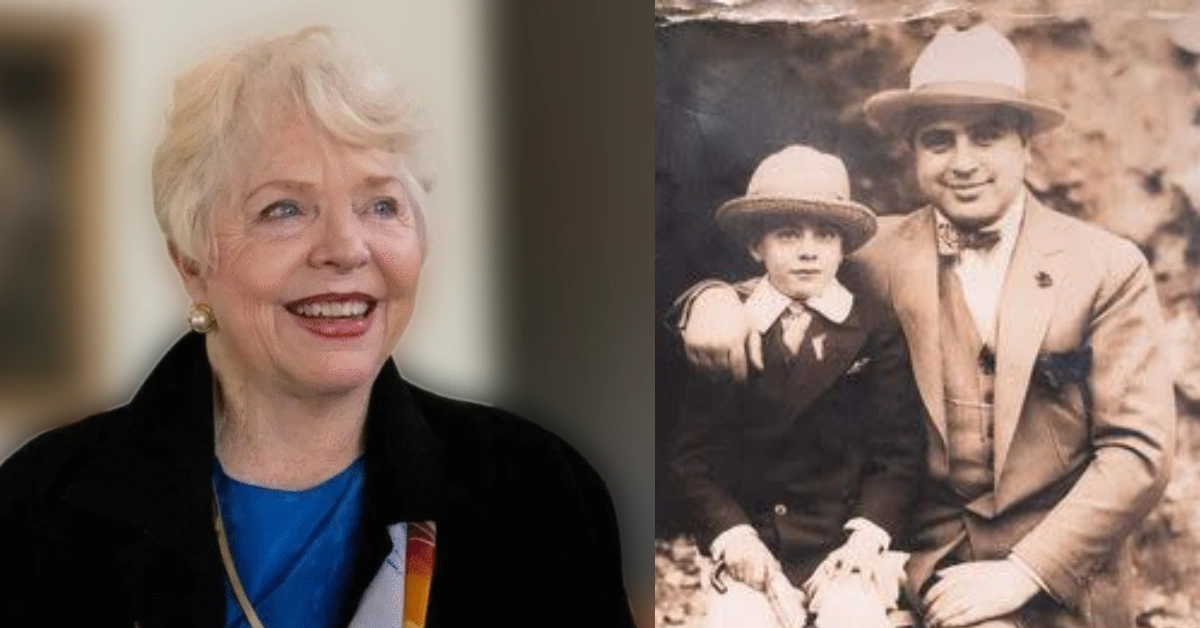
Veronica Capone didn’t ask to be born into America’s most infamous crime family. She spent 64 years proving surnames don’t determine destiny. As Al Capone’s eldest granddaughter, she built a quiet life in California’s tech industry—thousands of miles from Chicago’s criminal underworld.
Who Was Veronica Capone?
Veronica Frances Capone was born January 9, 1943, in Miami Beach, Florida. Her father was Albert Francis “Sonny” Capone—Al Capone’s only son. Her mother, Diana Ruth Casey, met Sonny as teenagers at St. Pat’s Catholic School in Miami Beach. They married in 1941.
Veronica never met her grandfather. He died in 1947, four years after her birth. She grew up as the eldest of four daughters in Miami Shores. She attended St. Mary’s Catholic School and graduated from Notre Dame Academy.
Questions about her last name followed her everywhere. Her father taught her and her sisters to handle these moments with dignity. Most people asked out of curiosity, not cruelty. This lesson shaped how Veronica carried her family name throughout her life.
In 1960, everything shifted. Marital difficulties between her parents prompted a move to Palo Alto, California. Veronica was 17. California became her permanent home—a fresh start on the opposite coast.
The Al Capone Shadow
Al Capone was born in Brooklyn in 1899. He moved to Chicago in the early 1920s and seized control of the Chicago Outfit during Prohibition. His empire ran on bootlegging, bribery, and violence. The government imprisoned him for tax evasion—ironically, not for his violent crimes.
Sonny Capone took a different path. He worked as an accountant in Florida. He deliberately kept distance from his father’s operations. His focus was simple: raise four daughters in a stable home. He wanted normal lives for them.
Veronica and her sisters faced awkward moments. Kids at school peppered them with questions. Adults made pointed comments. Their father’s guidance helped them navigate these situations without shame.
Marriage and Family
Veronica married twice. Her first husband, Bob Bacon, gave her three children: Rod, DeVon, and LeeRae. She raised them in Sunnyvale, California. That marriage ended in divorce.
She married Gordon Peterson in 1976. This marriage lasted 31 years—until her death. Gordon brought two children from his previous marriage. Veronica became stepmother to all five: Rod Bacon, LeeRae Bacon Walter, DeVon Bacon Harbolt, Eric Peterson, and Cassie Peterson.
The couple lived in the San Francisco Bay Area for years. When Gordon retired in 1990, they relocated to Auburn, California. Veronica spent her final 17 years there—away from Silicon Valley’s chaos.
Career in Semiconductors
Veronica worked over 20 years in California’s semiconductor industry. She held administrative and managerial positions at Fairchild Semiconductor in Mountain View. This wasn’t a token job—she worked there during the company’s peak years from the 1960s through 1980s.
Fairchild Semiconductor was a titan in Silicon Valley’s early days. The company developed transistors and integrated circuits that powered the tech revolution. Veronica’s work placed her at the center of California’s emerging tech boom.
She balanced her career with raising children. Her colleagues knew her as competent and professional. Most probably never connected her to her grandfather’s past—and that’s exactly how she wanted it.
Her career spanned California’s transformation into a tech hub. She witnessed semiconductors change everything—computers, telecommunications, consumer electronics. She contributed to that transformation through her daily work.
What Was Veronica Capone’s Net Worth?
Veronica Capone’s net worth remains undocumented. She chose privacy over publicity. Her career in administrative roles at Fairchild provided middle-class income. She never sought wealth or fame.
This privacy was deliberate. She wanted to escape the scrutiny attached to her surname. Financial records stayed private. Her lifestyle in Auburn suggested comfort without excess. She valued experiences over possessions.
Life Beyond Work
Veronica attacked life with passion. She traveled extensively—visiting countries across multiple continents. Africa captivated her. She returned there multiple times, drawn back by the continent’s complexity.
Her interests spread wide. Food, arts, film, ballet, music, literature—she consumed culture in all forms. She attended performances. She read constantly. She engaged deeply.
Politics energized her. She loved spirited debates about current events and policy. Yet she respected different viewpoints. These discussions didn’t drive wedges—they built connections. She never avoided difficult conversations.
Friends described her as someone who squeezed meaning from every moment. She didn’t let her family name become a cage. She built relationships based on who she was, not who her grandfather had been.
Final Battle
Doctors diagnosed Veronica with Acute Myelogenous Leukemia in June 2007. This aggressive blood cancer moves fast. She was 64.
She fought back hard. She spent nearly three months at Mercy San Juan Hospital enduring chemotherapy. The treatment ravaged her body. When standard treatments failed, her doctors recommended a clinical trial at Stanford Hospital.
She understood the risks. She told her family she might not survive. But she enrolled anyway—believing data from her participation might save someone else. This decision reflected her core: thinking of others while staring down death.
She battled for five months. On November 17, 2007, she died at Auburn Faith Hospital with her family around her. Private services were held December 1, 2007, in Auburn.
Living Beyond a Name
Veronica Capone spent 64 years proving family history doesn’t dictate individual identity. She worked in California’s tech industry during its formative decades. She raised five children. She explored the world. She engaged with arts, culture, and politics on her own terms.
She never hid her last name—but she never exploited it either. She built a life from her choices, not her grandfather’s crimes. When people asked about Al Capone, she answered honestly. Then she redirected the conversation.
Her story matters because it demonstrates how someone can carry a notorious surname without letting it become their entire identity. She worked hard. She loved her family. She pursued her interests. She maintained her dignity through it all.
Veronica outlived her grandfather by 16 years. Al Capone died at 48. She made it to 64. She used those extra years—and all the years before—to build something he never had: a quiet, meaningful life surrounded by people who loved her for herself.
Her husband of 31 years, Gordon, and her five children didn’t remember her as Al Capone’s granddaughter. They remembered Ronnie—the woman who loved Africa, debated politics with fire, and faced death with the same courage she’d shown her entire life.