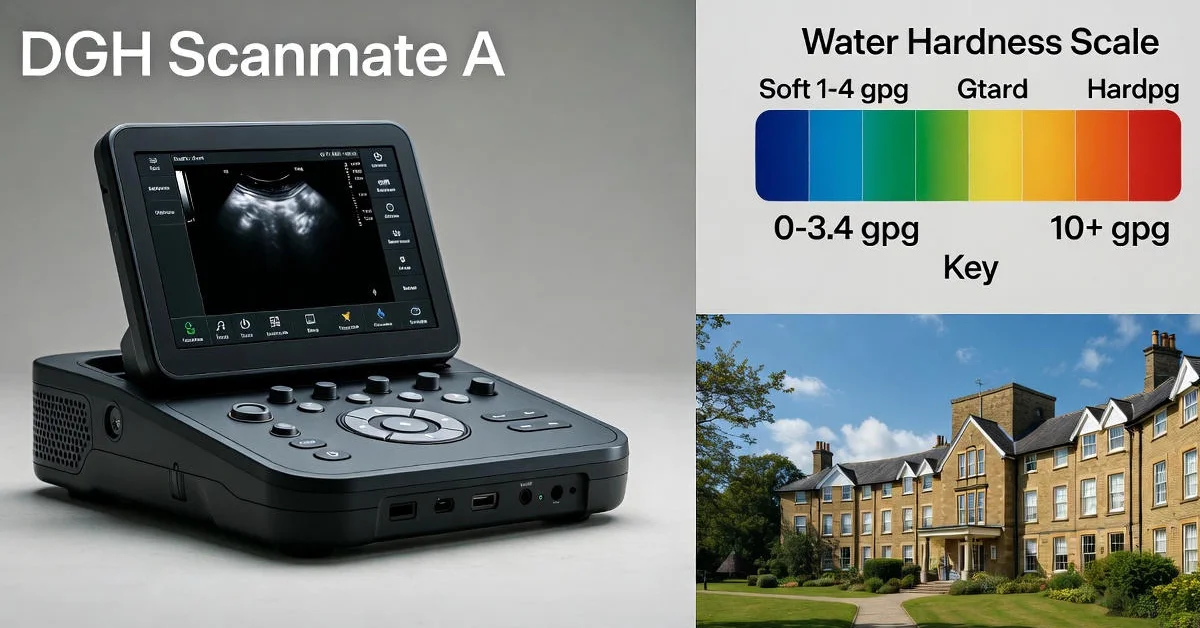
If you search for “DGH A,” you’ll likely find a confusing mix of medical diagrams, water chemistry charts, and vague business articles. This ambiguity happens because the term “DGH A” is an abbreviation used in three completely different industries: ophthalmology, water chemistry, and healthcare infrastructure.
The most prominent and commercially relevant meaning refers to the DGH Scanmate A, a specialized ultrasound device used by eye doctors. However, depending on your context, it could also refer to a unit of water hardness or a type of hospital in the UK.
This guide breaks down the verifiable facts for each definition, helping you find exactly what you’re looking for without the fluff.
The DGH A (Scanmate A): The Ophthalmic Biometer
In the medical field, “DGH A” is shorthand for the DGH 6000 Scanmate A, a portable A-Scan ultrasound device manufactured by DGH Technology, Inc. (based in Exton, Pennsylvania).
This device is a critical tool for ophthalmologists, specifically for A-Scan biometry. Before a patient undergoes cataract surgery, the surgeon must replace the cloudy natural lens with an artificial Intraocular Lens (IOL). To select the correct power for this artificial lens, they need precise measurements of the eye’s physical dimensions.
The DGH Scanmate A uses high-frequency sound waves to measure the eye’s axial length (the distance from the cornea to the retina), anterior chamber depth, and lens thickness.
How the DGH A Works
The device connects directly to a computer via USB, turning a standard laptop into a diagnostic station. It uses a 10 MHz transducer probe that sends sound pulses into the eye. These pulses bounce off the structures of the eye (cornea, lens, retina) and return to the probe. The software then calculates distances based on the time it takes for the echoes to return.
Critical Features for Clinicians
The DGH Scanmate A is distinct from older “box” units because of its software integration and safety features.
- Compression Lockout: One of the biggest risks in contact biometry is pressing the probe too hard against the eye, which temporarily shortens the eye’s shape and leads to inaccurate measurements. The DGH A software detects this “corneal compression” and automatically stops recording to prevent bad data.
- Dual Measurement Modes: It supports both Contact Mode (probe touches the eye) and Immersion Mode (probe sits in a Prager Shell filled with water). Immersion is generally considered the gold standard for accuracy as it eliminates corneal compression entirely.
- IOL Formulas: The accompanying software includes modern formulas (like SRK/T, Holladay, and Hoffer Q) to calculate the lens power automatically.
dGH: Degrees of General Hardness (Water Chemistry)
If you’re an aquarist, a coffee enthusiast, or a plumber, “dGH” has nothing to do with eye surgery. In this context, it stands for degrees of General Hardness (also known as German degrees or °dH).
This unit measures the concentration of divalent metal ions—primarily calcium (Ca²⁺) and magnesium (Mg²⁺)—dissolved in water.
Why dGH Matters
- Aquariums: Fish are sensitive to osmotic pressure. Tropical fish like Discus prefer soft water (low dGH), while African Cichlids require hard water (high dGH). Incorrect hardness can cause fish to go into shock.
- Coffee Brewing: Specialty coffee associations recommend a specific hardness range. Water with 0 dGH tastes flat, while very high dGH water causes limescale buildup in espresso machines.
Quick Conversion Table
If your test kit reads in PPM (parts per million) but your manual asks for dGH, use this conversion baseline:
| Unit | Conversion Factor |
|---|---|
| 1 dGH | 17.848 ppm (mg/L) of CaCO₃ |
| 1 dGH | 17.848 mg/L |
| 1 mmol/L | 5.6 dGH |
Example: If your water report says you have 100 ppm hardness, divide 100 by 17.848 to get approximately 5.6 dGH.
DGH in Healthcare: District General Hospital
In the United Kingdom, “DGH” is a standard acronym within the National Health Service (NHS) for a District General Hospital.
A District General Hospital is a major secondary care facility that provides a wide range of services—such as surgery, emergency care, and maternity units—to a specific local geographical area. It differs from a “Tertiary Centre” or “Teaching Hospital,” which handles more specialized, complex, or rare conditions.
When reading medical journals or NHS reports, you may see phrases like “data collected from DGH A and DGH B.” In this context, “DGH A” is simply a placeholder name for “Hospital A” in an anonymized study, not a specific product or code.
Debunking the “Project Management” Myth
While researching this term, you may encounter articles claiming “DGH A” is a “Decentralized Governance Hierarchy” or a “Data-Growth-Holistic” framework.
Be cautious: These definitions are widely considered to be AI-generated “hallucinations” found on low-quality content farms. There’s no recognized standard, academic framework, or methodology in professional project management known as “DGH A.” The verifiable, real-world meanings are the ultrasound device, the water unit, and the hospital classification.
Frequently Asked Questions
What’s the difference between A-Scan and B-Scan?
An A-Scan (like the DGH Scanmate A) provides a one-dimensional graph used for measuring eye length, whereas a B-Scan produces a two-dimensional cross-sectional image to view the eye’s internal structures.
How accurate is the DGH Scanmate A?
The device offers electronic resolution of 0.015 mm, making it highly precise for calculating intraocular lens power, especially when used in immersion mode.
What’s a safe dGH level for drinking water?
There’s no strict safety limit for hardness, but water between 4 and 8 dGH is often considered ideal for taste and preventing pipe corrosion or scale.
Who manufactures the DGH A?
The device is manufactured by DGH Technology, Inc., a medical technology company based in the United States that specializes in ultrasonic ophthalmic equipment.
Can I convert dGH to grains per gallon (gpg)?
Yes, 1 dGH is approximately equal to 1.04 grains per gallon (gpg), meaning they’re almost interchangeable for rough estimates.