The supreme court birthright citizenship case might reshape what it means to be American. President Trump’s executive order attempts to end automatic citizenship for certain babies born on U.S. soil, triggering a constitutional showdown that’ll be decided by the nation’s highest court in 2026. This legal battle challenges a 157-year-old constitutional guarantee and could affect hundreds of thousands of families annually.
Here’s what you need to know: The Supreme Court agreed in December 2025 to hear Barbara v Trump, a case challenging Trump’s executive order that would deny citizenship to children born in America if their parents lack specific immigration statuses. The Court will hear arguments this spring, with a decision expected by summer 2026. Until then, the order remains blocked, and birthright citizenship continues as it has since 1868.
Trump’s Executive Order Explained
On his first day back in office—January 20, 2025—President Trump signed Executive Order 14160, titled “Protecting the Meaning and Value of American Citizenship”. The order targets two groups of newborns. First, babies whose mothers are in the country unlawfully and whose fathers aren’t U.S. citizens or lawful permanent residents. Second, babies whose mothers hold temporary visas (like student, tourist, or work permits) and whose fathers also aren’t citizens or green card holders.
That means children born to parents on H-1B work visas, F-1 student visas, or even tourist visas could be denied citizenship. The policy was supposed to kick in on February 19, 2025, but federal courts immediately stepped in. Every judge who’s reviewed it has blocked the order, calling it unconstitutional.
Right now, the order can’t be enforced. Babies born in America still get citizenship automatically, just like they have for over 150 years.
What the Constitution Actually Says
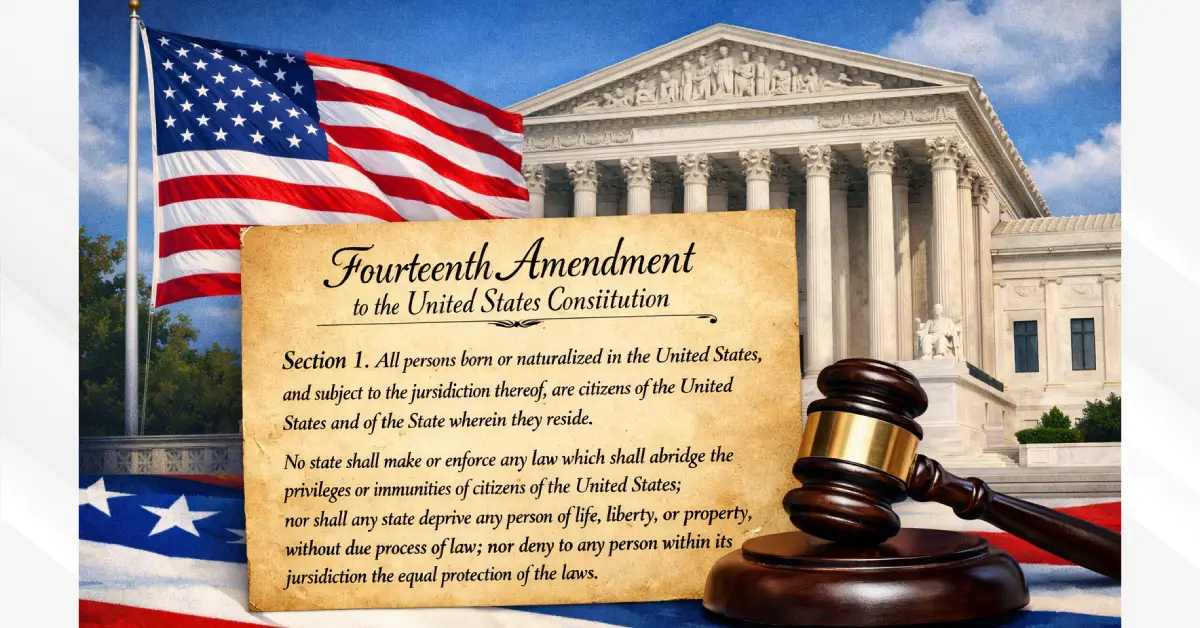
The 14th Amendment, ratified in 1868 after the Civil War, states clearly: “All persons born or naturalized in the United States, and subject to the jurisdiction thereof, are citizens of the United States”. Congress wrote this to overturn the notorious Dred Scott decision that had declared Black Americans couldn’t be citizens.
The framers deliberately chose broad language. They wanted to make sure citizenship couldn’t be denied based on race, ancestry, or parents’ legal status. In 1898, the Supreme Court confirmed this understanding in United States v Wong Kim Ark. Wong was born in San Francisco to Chinese immigrant parents who were legally in the country but couldn’t become citizens themselves because of racist exclusion laws.
When immigration officials tried to deny him entry after a trip to China, arguing he wasn’t a citizen, the Supreme Court ruled 6-2 that the 14th Amendment made him a citizen from birth. Justice Horace Gray explained that the Constitution “affirms the ancient and fundamental rule of citizenship by birth within the territory”. That precedent has stood for 127 years.
The Legal Fight Over Five Words
The entire Trump administration’s argument hinges on five words: “subject to the jurisdiction thereof”. Solicitor General D. John Sauer claims this phrase excludes children born to parents who are temporarily or unlawfully in the country. According to this view, the 14th Amendment was meant only for freed slaves and their descendants, not children of foreign nationals.
Legal experts say this interpretation twists both history and law. Harvard Law Professor Gerald Neuman noted that the executive order violates not just the Constitution but also federal citizenship statutes passed by Congress. The phrase “subject to the jurisdiction” has always meant territorial jurisdiction—basically, if you’re on U.S. soil, you’re subject to U.S. laws.
Only three narrow groups are excluded: children of foreign diplomats with immunity, children of invading enemy forces, and certain Native American tribes that maintained separate sovereignty. Undocumented immigrants and visa holders don’t fit these exceptions. They must follow U.S. laws, can be arrested and prosecuted, and have to pay taxes—all signs they’re under U.S. jurisdiction.
Twenty-five states filed briefs supporting Trump’s position, led by Tennessee and Iowa. But 22 states sued to block the order, arguing it violates clear constitutional text.
How This Reached the Highest Court
Within hours of Trump signing the order, the ACLU and partner groups filed lawsuits. By February 2025, courts across the country had issued injunctions blocking it. Judge John Boardman wrote that “The United States Supreme Court has resoundingly rejected the president’s interpretation of the citizenship clause”.
Instead of appealing on constitutional grounds, the Trump administration challenged whether judges can issue nationwide injunctions. On June 27, 2025, the Supreme Court ruled 6-3 in Trump v CASA that universal injunctions exceed judicial authority. But the Court didn’t rule on whether the order itself was constitutional.
That same day, the ACLU filed Barbara v Trump, a class action lawsuit in New Hampshire. The lead plaintiff is a pregnant woman identified only as “Barbara” to protect her safety. Judge Joseph Laplante certified a class covering all children born on or after February 19, 2025, who’d be denied citizenship under the order.
In December 2025, the Supreme Court agreed to hear the case. This time, there’s no procedural escape route—the justices will have to decide whether Trump can reinterpret the Constitution by executive order.
What’s at Stake for Families
If the supreme court birthright citizenship case goes Trump’s way, the consequences would be massive. First, it’d create stateless children—babies born in America who no country recognizes as citizens. Many countries don’t grant citizenship based on parents’ nationality if the child was born abroad.
These kids couldn’t get Social Security numbers or passports. They’d lose access to healthcare programs like CHIP and nutrition assistance. As adults, they couldn’t vote, serve on juries, or hold many jobs. They couldn’t get driver’s licenses or open bank accounts.
Researchers estimate the unauthorized population would grow by 4.7 million by 2050 if birthright citizenship ended—and that’s just counting children of undocumented parents. Trump’s order is broader, affecting temporary visa holders too. This would create what experts call a “self-perpetuating class” excluded from society for generations.
States would also take a financial hit. Children need healthcare, education, and sometimes foster care. If the federal government won’t recognize these children as citizens, states would either absorb full costs or deny services to American-born kids.
Timeline and What Happens Next
The Supreme Court will hear oral arguments in spring 2026, likely between March and May. After arguments, the justices deliberate and write their opinions, usually releasing major decisions in late June or early July.
Until the Court rules, the executive order stays blocked. Babies born in the United States continue receiving citizenship automatically, just as they have since 1868. But immigration attorneys are advising affected families to keep careful documentation and consult lawyers about their specific situations.
The U.S. is one of only 33 countries with unrestricted birthright citizenship, mostly in the Americas. Canada and the U.S. are the only developed nations that still guarantee it. Most European and Asian countries grant citizenship through parents rather than birthplace.
This stability since 1868 reflects both clear constitutional text and practical recognition that automatic citizenship promotes integration. Changing it now would fundamentally alter American society.
The Bottom Line
The supreme court birthright citizenship decision will be one of the most important rulings in decades. It’s not just about immigration policy—it’s about whether a president can rewrite the Constitution by executive order and whether children can inherit second-class status based on their parents’ circumstances.
Every federal judge who’s examined Trump’s order has rejected it as contrary to constitutional text, Supreme Court precedent stretching back 127 years, and federal law. The 14th Amendment’s language is plain, and its history is clear. But six conservative justices now hold the power to decide whether those guarantees still mean what they’ve always meant.
Families across America are watching and waiting. The answer will shape not just their lives, but the meaning of citizenship itself for generations to come.