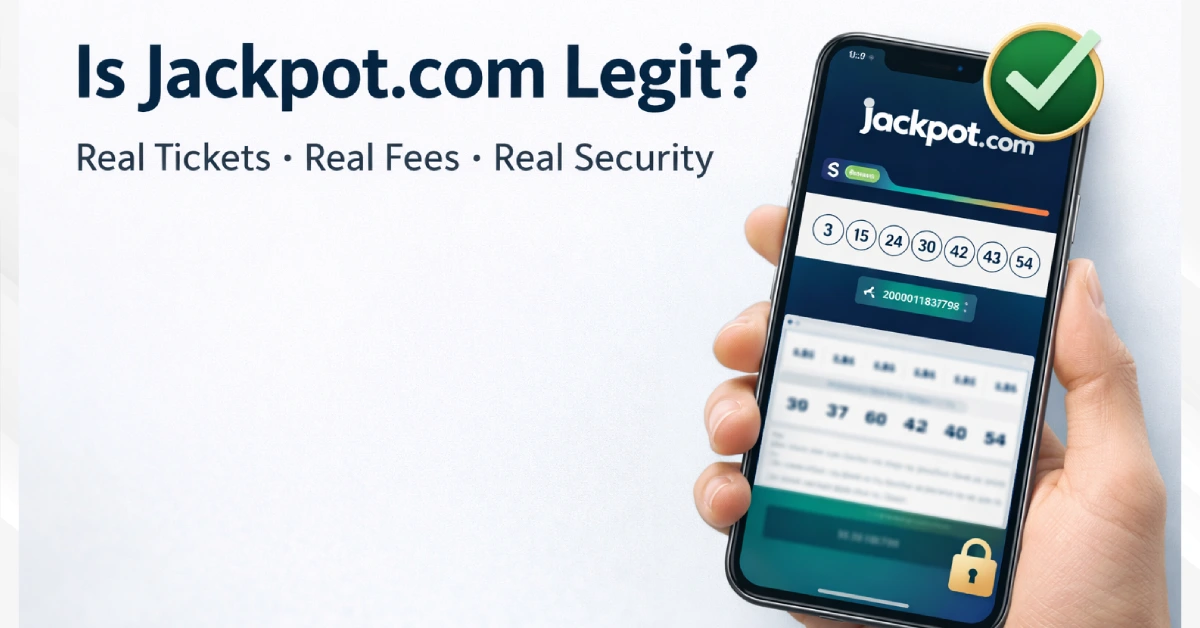
Is Jackpot.com legit? The short answer is yes—but with important caveats you need to know. Jackpot.com operates as a licensed lottery courier service that buys actual state lottery tickets on your behalf. It’s not a scam. However, the platform comes with trade-offs around fees, processing times, and regulatory uncertainty that make it worth understanding before you download the app.
Understanding Jackpot.com and How It Works
Jackpot.com lets you purchase official state lottery tickets through your phone or computer instead of visiting a retailer. The company’s agents physically buy real tickets from authorized retailers, scan them, and upload digital copies to your account. You’re not betting on lottery results—you’re getting actual tickets issued by your state’s lottery commission.
The platform operates in seven U.S. states: Arizona, Arkansas, Colorado, Massachusetts, New Jersey, New York, and Ohio. You can buy Powerball, Mega Millions, and state lotteries. Founded in 2016 and headquartered in San Francisco, it has established infrastructure.
Here’s the fee reality. Jackpot.com charges 10-20% on deposits depending on your state. Drop $50? You’re paying $55-$60 total. No fees on winnings—only deposits. That means lottery costs significantly more than retail.
Legal Status and Regulatory Framework
Jackpot.com operates legally in the states where it’s available. Think of it like food delivery services—your state’s lottery commission treats these courier services similarly to how Instacart operates for groceries. Only New Jersey and New York have formal licensing frameworks specifically for lottery couriers. Other states where Jackpot.com works view it as permissible under existing law, though the landscape keeps shifting.
This regulatory flexibility is the weak point. Texas banned courier services entirely in February 2025 after investigating large jackpot wins through these platforms. California’s Attorney General already ruled in 2022 that courier services violate state law. Connecticut banned them outright in October 2025. The takeaway? Your state’s rules could change, and if you’re in a gray area, you might lose access unexpectedly.
The international version of Jackpot.com (lotto.jackpot.com) is completely separate. It holds a Malta Gaming Authority license and operates as a betting platform, not a lottery courier. Don’t confuse the two—they’re different services with different legal frameworks and business models.
What Do User Reviews Reveal About Jackpot.com?
Customer experiences vary widely. On Trustpilot, Jackpot.com sits at 2.5 out of 5 stars with over 1,000 reviews. Some praise convenience and transparent scanning. Others complain about withdrawal delays and verification hassles.
The BBB shows complaints about: delayed withdrawals lasting weeks instead of 3-5 business days, excessive verification documents, and slow customer support. Many get resolved eventually—the company processes late payments after escalation. Positive reviewers highlight convenience and automatic result checking. Negative reviewers focus on hidden deposit costs and slow support.
How Secure Are Transactions and Personal Data?
Your data and money are protected reasonably well. Jackpot.com uses SSL encryption for all data transmission, follows PCI compliance standards for payment info, and stores physical tickets in locked, fireproof vaults with 24-hour video surveillance. Ticket images are watermarked with your name visible while keeping serial numbers protected.
Before your first withdrawal, you’ll need government-issued ID verification and age confirmation (18+ generally, 21+ in some states). Location verification confirms you’re physically in an authorized state. Larger withdrawals trigger additional documentation requests. This feels invasive to some users, but these are standard “know your customer” practices banks use too.
You can pay with credit cards, debit cards, ACH transfers, PayPal, and Skrill. The company doesn’t store your complete financial information on their servers, and deposits and withdrawals go through separate verification checkpoints. It’s not perfect security, but it’s solid.
Fee Structure and Costs
Those deposit fees hit harder than you’d think. New Jersey charges 15%, Colorado charges 15-20%, and the general platform charges 10-20% depending on your state. There’s no per-ticket fee—you cover all costs at deposit. No fees on withdrawals either, whether you’re taking out $100 or $10,000.
Play $50 weekly? That’s an extra $260-520 annually just in convenience fees compared to retail. For casual players, that might feel worth it. For serious players who spend hundreds monthly, it gets expensive fast. The fees fund Jackpot.com’s operations—they’re how the company makes money.
What you do get for those fees: 24/7 access instead of store hours, automatic result checking instead of manual ticket scanning, digital proof of purchase stored permanently, and no lost ticket risk since everything’s scanned.
Prize Claiming Process and Payout Timelines
Under $600? Jackpot.com claims your prize automatically after official results post. Money deposits into your account balance within 3-5 business days for verified accounts. First-time withdrawals might take 24-72 hours for identity verification. You get instant email and push notifications when you win—no checking tickets manually at 11 PM.
Over $600 requires direct claims through your state lottery office. Jackpot.com secures delivers the physical ticket to your address and helps guide you through the claiming process. You claim prizes directly from the state, not through Jackpot.com. This matters legally—it ensures you receive full prize amounts without a third party taking a cut.
Larger withdrawals extend verification timelines up to 5 business days. Credit card refunds process within 72 hours after approval. These aren’t lightning-fast, but they’re transparent and standard for financial services.
Is Jackpot.com Different from Jackpota?
Three distinct services get confused constantly. Jackpot.com is the U.S. lottery courier buying real tickets. Jackpota is a sweepstakes casino operating in 40+ states with no actual lottery tickets involved—it’s social gaming with virtual coins. Jackpocket is a competitor lottery courier (owned by DraftKings) operating in 17 states.
Different platforms mean different legal frameworks, business models, and payout mechanisms. Check which service you’re considering before signing up.
Responsible Gaming Tools and Player Protection
Jackpot.com offers spending limits you can set daily, weekly, or monthly. Decreases take effect immediately. Increasing limits requires a 24-hour waiting period to prevent impulse decisions. You can set reality check reminders at intervals you choose, time out from 24 hours to a month, or self-exclude for 6 months to 5 years permanently.
The company earned the National Council on Problem Gambling’s 2019 Best Corporate Social Responsibility Award and holds their iCAP certification. Customer support is trained on problem gambling issues. These aren’t just marketing claims—they’re backed by third-party recognition.
What Are Common Customer Complaints?
Most complaints cluster around three areas: withdrawal delays beyond stated timelines (especially for first-time large withdrawals), verification requirements that feel excessive, and limited customer support availability. Scratch-off ticket shipping causes delays between purchase and result notification. The 10-20% deposit fee also surprises users unfamiliar with the courier model.
These aren’t red flags indicating fraud. Verification is standard KYC practice. Shipping delays are logistics. Account reviews on large wins are anti-fraud measures. But they are legitimate operational complaints worth considering.
Should You Use Jackpot.com?
Use it if you value convenience over cost savings, live in one of the seven supported states, and can afford the deposit fees. It’s genuinely useful for forgetful players who’d skip playing otherwise.
Skip it if you play frequently and high-volume—fees add up quickly. Also avoid if you’re in states with regulatory uncertainty or need instant scratch-off results. Traditional retailer visits or your state’s official lottery website might serve you better.
Jackpot.com is legit. It’s not a scam. But legitimacy doesn’t mean perfect. The platform struggles with withdrawal delays, charges premium fees for convenience, and operates under evolving regulations. Success here depends on knowing what you’re paying for, your state’s legal status, and realistic expectations. Make an informed choice based on your actual needs.