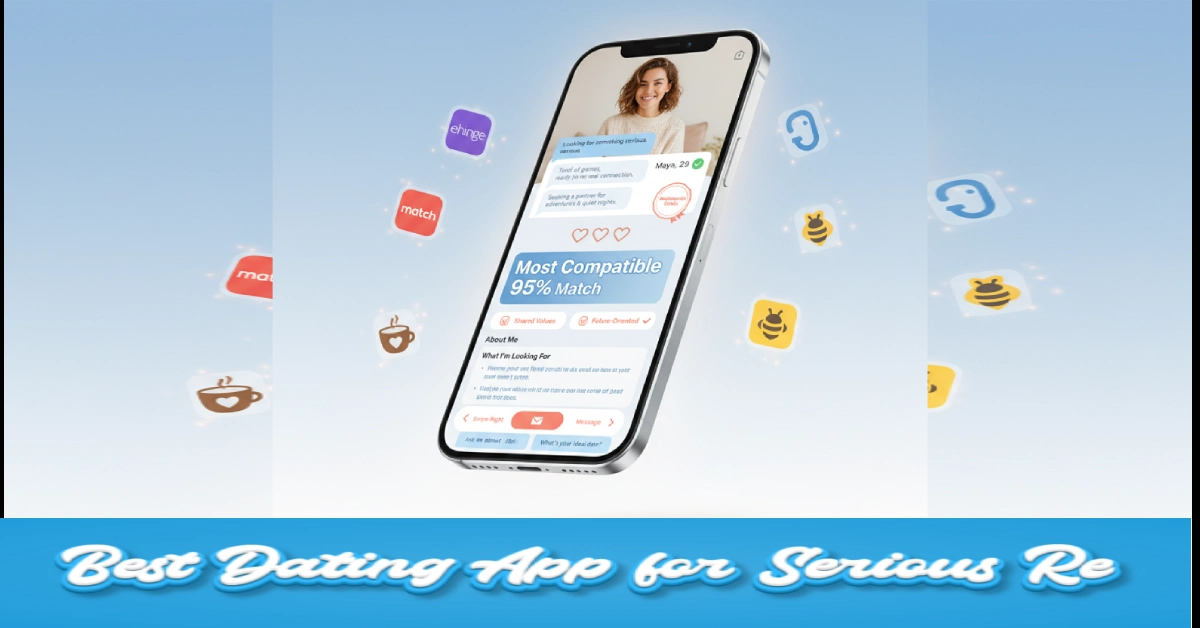
Finding the right person isn’t easy. But what if the best dating app for serious relationships could actually help? Forget what you’ve heard about dating apps being just for hookups. Things have changed big time.
Nearly 40% of couples now meet online. That’s almost half of all relationships starting through an app or website. And here’s the kicker—68% of people using dating apps in 2025 said they wanted serious relationships, not just casual flings. That’s up from 52% in 2020.
So yeah, dating apps work. But not all of them work the same way. Some are built for quick swipes and weekend plans. Others are designed to help you find someone you’ll actually want to stick around with.
This guide breaks down which apps are worth your time if you’re looking for something real. We’ll cover what makes an app good for serious dating, compare the top choices, and share tips to help you succeed.
Why Dating Apps Matter for Finding Serious Relationships
Let’s be honest—meeting people in real life is tough. You work 40+ hours a week. Your friend group is pretty much set. And walking up to a stranger at a coffee shop? That feels awkward for most people.
Dating apps solve this problem. They put thousands of potential matches right in your pocket. You can browse profiles while watching TV, during your lunch break, or whenever you’ve got five free minutes.
But here’s what really matters: dating apps let you filter for what you want. Looking for someone who shares your religion? Done. Want to find people who actually want kids someday? You can set that as a requirement. This level of filtering just doesn’t happen when you randomly bump into someone at a grocery store.
The numbers back this up too. Among people under 30 who are in relationships, one in five met their partner through a dating app. For older adults, it’s still one in ten. These aren’t small numbers.
Here’s what changed the game:
- Apps now let you state what you’re looking for upfront
- Better matching algorithms connect people who actually fit
- Safety features (like photo verification) filter out fake profiles
- More people are being honest about wanting commitment
The key is picking the right app and using it the right way. That’s what the rest of this article is all about.
What Makes a Dating App Truly “Best” for Serious Relationships
Not all dating apps are created equal. Some are basically window shopping for dates. Others help you find someone who could actually become your future spouse. So what separates the good from the not-so-good?
Detailed profiles matter most. Apps that only show five photos and a one-line bio? Those are hookup apps pretending to be relationship platforms. The best apps for serious dating make you fill out real information—your values, what you’re looking for, how you spend your free time, what matters to you in a partner.
Think about it: how can an app find you a good match if it only knows what you look like?
Advanced matching beats mindless swiping. The top relationship apps use actual algorithms. eHarmony, for example, has an 80-question compatibility quiz. Hinge uses a system that learns what you like and suggests better matches over time. Coffee Meets Bagel only sends you a few high-quality matches each day instead of overwhelming you with thousands of profiles.
Simple location and age filters aren’t enough when you’re looking for a life partner.
Safety features show serious intent. Apps with photo verification, ID checks, and background screening attract real people with real intentions. When someone has to verify their face matches their photos, it weeds out catfishers and scammers. This might sound annoying, but it means the person you’re talking to is actually who they claim to be.
The right crowd makes all the difference. Here’s something interesting: paid apps tend to work better for serious relationships. Why? Because people willing to spend $20–$60 per month are serious about finding someone. Free apps attract everyone—including people just looking to kill time or boost their ego.
Match.com reports that 70% of their users want serious relationships. On Hinge, 90% of Gen Z users are looking for something real. Compare that to Tinder, where the majority still prefer casual dating.
User demographics tell you a lot. Apps that attract older users (30+) or professionals tend to be better for relationships. Why? These folks have less patience for games and more interest in settling down.
Bottom line: the best dating app for serious relationships has detailed profiles, smart matching, safety features, and attracts people who actually want commitment.
Top Dating Apps for Serious Relationships Compared
Let’s get into the actual apps. Here’s what works and who each one is best for.
Hinge: The Relationship-Focused Leader
Hinge literally markets itself as “the app designed to be deleted.” That should tell you everything. This app is built for people who want to get off dating apps by finding someone.
What makes Hinge different? You can’t just swipe yes or no. You have to like or comment on specific parts of someone’s profile—a photo, an answer to a prompt, whatever. This forces actual engagement instead of mindless swiping.
Hinge profiles use conversation-starter prompts like “A life goal of mine is…” or “I’m looking for…” These give you real things to talk about instead of starting with “hey what’s up.”
The app’s “Most Compatible” feature uses a Nobel Prize-winning algorithm (seriously) to suggest your best match each day. Users who match with their Most Compatible are eight times more likely to exchange phone numbers and meet up.
Best for: Young professionals aged 24-35 who want modern features but serious intent. If you like the idea of detailed profiles but don’t want something as rigid as eHarmony, Hinge is your sweet spot.
Cost: Free version available; premium starts around $20/month
eHarmony: The Marriage-Backed Platform
eHarmony has helped create over 600,000 marriages in the U.S. That’s not an exaggeration—that’s actual data. This app is for people who are 100% ready to find a spouse, not just a girlfriend or boyfriend.
The platform starts with an in-depth compatibility quiz. It takes 10-20 minutes and covers everything: personality type, communication style, values, relationship expectations, deal-breakers. eHarmony’s algorithm then sends you matches based on deep compatibility, not just surface-level attraction.
Here’s something unique: eHarmony might actually reject your application if your quiz answers suggest you’re not serious or if you’re already married. They’re picky about who they let in. This is a good thing—it means everyone on the app shares your goal.
Research from the University of Chicago found that couples who met on eHarmony were more likely to stay married than couples who met offline. Among eHarmony marriages, 87% of couples say they’re still in love years later.
Best for: Anyone 30+ who wants marriage, not just dating. If you’re willing to invest time and money for quality matches, eHarmony delivers.
Cost: Premium membership starts at $66/month (but cheaper with longer subscriptions)
Match.com: The Versatile Veteran
Match is like the grandfather of dating apps—it’s been around forever and still works really well. It has the largest user base, which means more potential matches, especially if you’re in a smaller city.
Users on Match tend to be older (50+ folks are five times more likely to use Match than Tinder). The platform offers detailed search filters so you can specify exactly what you want: education level, income, whether they have kids, relationship goals, lifestyle habits.
Match also hosts in-person singles events, which is cool if you want to meet people face-to-face without the awkwardness of traditional meetups.
Best for: Anyone over 35 looking for serious relationships but who wants flexibility in how they search and connect. Good option if you want a big user pool.
Cost: Starts at $22/month
Bumble: Where Intention Meets Innovation
Bumble got famous for letting women message first in straight matches, but it’s evolved into a solid relationship app. The platform shows 82% of users are looking for long-term relationships.
Bumble’s profiles include badges that clearly state what someone’s looking for (relationship, something casual, etc.). This transparency saves everyone time. The app also has photo verification to make sure profiles are real.
One cool feature: extended matches. If you really like someone, you can give them extra time to respond, which shows genuine interest instead of just mass-swiping.
Best for: People 25-40 who want a balance between serious intent and modern app features. It’s more commitment-focused than Tinder but less intense than eHarmony.
Cost: Free version works well; premium starts around $17/month
Coffee Meets Bagel: Quality Over Quantity
Coffee Meets Bagel (CMB) fights swipe fatigue by only sending you a few “bagels” (matches) each day at noon. That’s it. No endless scrolling. No decision paralysis.
The app’s algorithm learns your preferences over time and gets better at suggesting compatible matches. Over 91% of CMB users want committed relationships—the highest percentage of any major app.
Users report having deeper conversations on CMB compared to other apps. People ask meaningful questions like “What do you value most in a long-term relationship?” instead of generic small talk.
Best for: Millennial professionals who are tired of swiping and want curated, high-quality matches. Perfect if you want to be thoughtful about dating instead of treating it like a numbers game.
Cost: Free with in-app purchases for extra features
Quick Comparison Table
| App | Best For | User Intent | Starting Cost |
|---|---|---|---|
| Hinge | Ages 24-35, modern serious daters | 90% want relationships | Free / $20/mo |
| eHarmony | 30+, marriage-focused | Marriage-minded | $66/mo |
| Match.com | 35+, broad user base | 70% want serious | $22/mo |
| Bumble | 25-40, balanced approach | 82% want relationships | Free / $17/mo |
| Coffee Meets Bagel | Tired of swiping | 91% want commitment | Free with IAP |
Specialized Dating Apps for Specific Demographics
Maybe you fit into a specific category. Here are apps designed for particular groups.
SilverSingles targets people over 50. About 80% of users are in this age range. The app uses personality-based matching and sends 3-7 curated matches daily. The interface is simple and easy to navigate, which appeals to folks who don’t want complicated technology. Premium plans start at $17.95/month.
EliteSingles focuses on educated professionals. Over 80% of members have bachelor’s, master’s, or doctorate degrees, and most are above age 30. If you’re career-driven and want someone on a similar level, this app attracts that crowd. Premium starts at $16.95/month.
OkCupid stands out for its extensive questionnaire system. You can answer thousands of questions, and the app calculates compatibility percentages. It’s also explicitly LGBTQ+ friendly, offering over 60 gender identities and sexual orientations. The free version has solid features, making it accessible for serious daters not ready to pay.
Faith-based options: Christian Mingle and JDate cater to religious communities. If shared faith is non-negotiable for you, these platforms connect you with like-minded believers.
Don’t ignore these niche apps if they fit your situation. Sometimes a smaller, more targeted pool gives you better results than a massive generic one.
Free vs. Paid Dating Apps: Which Should You Choose?
This is a common question: should you pay for a dating app?
Here’s the truth—both can work, but they work differently.
Paid apps create commitment. When someone drops $20-$60 per month on an app, they’re serious about finding someone. Free apps attract everyone, including people just browsing for entertainment or ego boosts. Paid platforms filter out casual users.
Studies show people who pay for dating app features report slightly better experiences (58% positive) compared to those who only use free versions (50% positive). It’s not a huge difference, but it matters.
Paid features that actually help:
- Seeing who already liked you (saves time)
- Unlimited likes/swipes
- Advanced filters (dealbreakers, specific traits)
- Read receipts on messages
- Profile boosts to get more visibility
Free apps that still work well:
- OkCupid offers detailed profiles and compatibility scores for free
- Bumble’s free version has solid functionality
- Hinge lets you like and match without paying
The real answer? Start with free versions. Test a couple apps for 2-3 weeks. If you’re getting good matches and conversations, stick with free. If you’re struggling or want better filters, upgrade to premium for a month and see if it makes a difference.
Your approach matters more than whether you pay. A half-hearted paid user will get worse results than someone fully engaged with a free app.
How to Maximize Your Success on Serious Dating Apps
Having the right app doesn’t guarantee success. You’ve got to use it well.
Profile optimization is everything. Use recent, clear photos. Fill every photo slot (most apps give you 5-9 spots). Include variety: a clear face shot, a full-body photo, one showing a hobby, maybe one with friends. Avoid group photos where people can’t tell which one is you.
Complete all profile sections. Answer the prompts thoughtfully. Show personality. “I like to travel” is boring. “I’m planning a trip to Peru next spring because I’ve always wanted to hike Machu Picchu” is interesting.
State you’re looking for something serious. Most apps let you set this preference—use it. This filters out people who want different things.
Actually message your matches. This sounds obvious, but tons of people match and never say anything. Start conversations within 24 hours. Ask questions about something specific in their profile. Generic “hey” messages get ignored.
Move to real meetings quickly. Don’t text for weeks. If you’re vibing with someone, suggest meeting for coffee or a walk within the first week. You’ll find out if there’s real chemistry way faster in person than through endless messaging.
Set boundaries around safety:
- Don’t share your home address early on
- Meet in public places for first dates
- Tell a friend where you’re going
- Video chat before meeting if you want extra reassurance
- Never send money to someone you met online
Avoid these red flags:
- Anyone who won’t video chat (possible catfisher)
- People who move conversations off-app immediately (potential scammer)
- Excessive compliments too early (love bombing)
- Vague answers about their life (hiding something)
- Refusing to meet after weeks of talking (time-waster)
Limit your swiping to 10-15 minutes daily. More than that leads to burnout and treating people like products instead of potential partners.
Dating App Safety and Verification Features in 2026
Safety has gotten way better in the last few years. Apps know they have to protect users or lose them to competitors.
Major safety features now standard:
- Photo verification: You take a selfie mimicking a pose, and AI confirms it matches your profile photos
- ID verification: Some apps check government IDs to confirm you’re a real person
- Facial recognition: Tinder’s “Face Check” reduced suspicious accounts by 40%
- Background checks: Some premium services screen for criminal records
Bumble, Hinge, Match, and eHarmony all have strong safety tools. Lesser-known apps might skip these features, which should make you cautious.
How to spot fake profiles:
- Photos look too professional or model-like
- Profile has very little written information
- They immediately want to move to text or email
- Story doesn’t add up or changes
- They’re “traveling for work” and can’t meet
What to share and what to keep private:
- ✅ Share: First name, general area you live (city, not exact address), what you do for work
- ❌ Keep private: Last name (until you’ve met), exact workplace, home address, daily routine details, financial information
All serious apps have reporting and blocking features. If someone makes you uncomfortable, don’t hesitate—report them and move on. The app’s moderators will investigate.
Trust your gut. If something feels off about a person, it probably is.
Success Stories and Real Data on Dating App Relationships
Do dating apps actually lead to lasting relationships? Yes—here’s proof.
eHarmony has facilitated over 600,000 marriages in the United States. The platform reports 438 marriages per day among couples who met through their service. Research found that 7% of couples who met on eHarmony got married within the first year—the highest success rate of any dating platform studied.
One study showed couples who met online were less likely to divorce than couples who met offline. Among eHarmony marriages specifically, 87% of couples report still being in love years later, and 80% say they’re happy with their partner.
Dating apps overall have become the primary way modern couples meet. One in ten adults in relationships met their partner through an app. For adults under 30, it’s one in five.
Real timeline expectations:
Most successful app couples message for 1-2 weeks before meeting. They usually have 2-5 dates before deciding if there’s real potential. Exclusive relationships typically develop within 2-3 months of the first date. Engagements often happen 1-2 years after meeting.
This isn’t instant. Finding a serious relationship takes time whether you meet online or offline. But apps speed up the process of finding compatible people to date.
Success stories are everywhere once you look. Couples post about meeting on Hinge, getting engaged after meeting on Match, or celebrating anniversaries from Coffee Meets Bagel connections. These stories are real—apps work when you approach them seriously.
The Future of Serious Dating Apps and 2026 Trends
Dating apps keep evolving. Here’s what’s happening now and what’s coming next.
Authenticity is winning. People are tired of overly curated profiles. The trend called “clear-coding” means being upfront about intentions, flaws, and what you really want. Apps are adding features that encourage this honesty.
Video and voice integration. More apps now let you add voice notes to profiles or send video messages. This shows personality way better than text. Expect this to become standard across all platforms.
AI matching gets smarter. Algorithms are learning faster. They consider not just your preferences but how you actually engage with profiles, what leads to conversations, which matches you respond to quickest. The AI figures out what you need better than you do sometimes.
Safety becomes non-negotiable. Every major app is adding verification. Facial recognition, ID checks, and behavior monitoring to catch scammers are becoming expected features, not premium add-ons.
Community features beyond matching. Some apps are experimenting with group events, friend-finding modes, and community discussions. The idea is building connection beyond just one-on-one dating.
Less swipe culture, more intention. Apps are moving away from the “swipe until your thumb hurts” model. Limited daily matches, thoughtful prompts, and features that encourage real conversation are replacing mindless browsing.
The future looks good for people wanting serious relationships. Apps are finally catching up to what users actually need.
Conclusion: Your Path to Finding Real Love Online
The best dating app for serious relationships depends on who you are and what you’re looking for. If you’re under 35 and want modern features with serious intent, try Hinge. If you’re ready for marriage, eHarmony has the track record. If you want a big user pool and flexible searching, go with Match. Tired of endless swiping? Coffee Meets Bagel delivers quality over quantity.
Here’s what matters most: pick an app that fits your age group and goals, create a complete and honest profile, engage consistently, and be willing to meet people in real life.
Dating apps aren’t magic. They’re tools. They work when you use them seriously and give people a real chance. The data proves it—40% of relationships now start online, hundreds of thousands of marriages happen because of these apps, and success rates keep climbing.
Stop waiting for the perfect person to randomly appear in your life. Download one of these apps today, fill out your profile completely, and start connecting. Your future partner might be waiting to match with you right now.
Ready to get started? Pick the app that sounds best for your situation, commit to giving it at least 30 days of genuine effort, and see what happens. You might be surprised how quickly things can change when you’re on the right platform with the right approach.