

The Learjet 55 is one of those aircraft that quietly built a strong reputation without making much noise about it. Developed by Gates Learjet in the early 1980s and later supported under Bombardier, it filled a gap between small light jets and heavier, more expensive cabin-class aircraft. Around 147 units were delivered before production wrapped up in the early 1990s, and many of those jets are still flying today.
This article covers everything you’d want to know — how it was designed, what it can do, who’s buying and chartering it, and what the safety record looks like, including the most recent incident from early 2025.
Overview of the Learjet 55
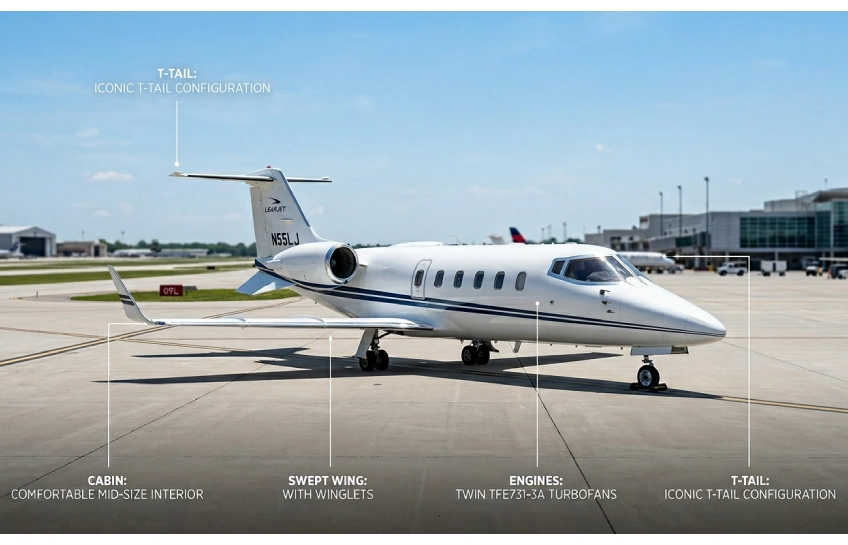
The Learjet 55, nicknamed the “Longhorn,” was positioned as a mid-size corporate jet for operators who needed more cabin space and range than a light jet could offer, without the operating costs of a large-cabin aircraft. It served private business transport, charter operators, and medical evacuation teams — and it still does today.
Even after 40 years, you’ll find Learjet 55s operating charter routes, corporate shuttles, and air-ambulance missions across North and South America. Its combination of speed and altitude capability made it a practical choice for medical operators who need to get a patient somewhere fast.
Development and Design
Gates Learjet announced the 50-series concept in 1977, initially planning three variants — the 54, 55, and 56. But only the Learjet 55 made it into production. Engineers took the “Longhorn” wing from earlier Learjet development work, added winglets borrowed from the Learjet 28/29, paired it with a larger fuselage, and fitted it with Honeywell TFE731 turbofan engines. Together, those changes reduced drag and improved fuel efficiency compared to the older turbojet Learjets in the 20-series.
Structurally, the aircraft follows a fairly conventional layout: a low-wing cantilever monoplane with a T-tail, rear-fuselage engine mounting, and retractable tricycle landing gear. So while it looks like a classic business jet, the aerodynamic improvements underneath were meaningful for its era.
Key Specifications and Performance
The Learjet 55 cruises comfortably between 400 and 450 knots and can reach a service ceiling of around 51,000 feet — well above most commercial air traffic. Its range falls roughly between 1,800 and 2,500 nautical miles depending on payload and configuration, making it capable of transcontinental hops without a fuel stop in many cases.
Below is a quick reference for the key numbers:
| Parameter | Typical Value |
|---|---|
| Max Takeoff Weight | ~21,500 lb |
| Max Cruise Speed | ~464 knots |
| Long-Range Cruise Speed | ~391 knots |
| Range | ~2,100 nm |
| Service Ceiling | ~51,000 ft |
| Takeoff Distance | ~5,000–5,600 ft |
| Landing Distance | ~2,700–2,800 ft |
Cruise altitudes typically sit in the low-40,000-foot range under normal operations. Takeoff distance runs between 5,000 and 5,600 feet at sea level, which keeps it accessible at a wide range of regional airports.
Cabin Layout and Comfort
One of the bigger selling points of the Learjet 55 was its cabin — noticeably more spacious than the narrow tubes found in earlier Learjet models. It measures roughly 5.7 feet high, 5.9 feet wide, and 16 to 17 feet long, giving passengers room to move around without feeling cramped.
Typical seating layouts accommodate 7 to 10 passengers, usually in a club configuration with options for side-facing divans, an enclosed lavatory, and a small galley depending on how the operator configures it. Baggage capacity runs to about 60 cubic feet total, split between internal and external compartments — practical for business trips and, just as importantly, for the medical gear that air-ambulance operators need on board.
Variants and Upgrades
The Learjet 55 family includes four main variants: the original 55, the 55B, the 55C, and the extended-range 55ER. Each generation addressed specific operator feedback and performance targets.
The 55B brought wing refinements and moved toward a more modern digital flight deck, replacing the original analog instrument layout. Then the 55C added “delta fins” at the rear of the fuselage — a small but effective change that improved handling and lateral stability. That same delta fin design was later carried over to other Learjet types.
The 55ER extended the aircraft’s legs by adding extra fuel capacity in the tail cone. Brazil’s Air Force also operated a version under the designation VU-55, used as a VIP transport.
How Safe Is the Learjet 55?
The Learjet 55 fleet is relatively small, and most of those aircraft operate in corporate, charter, and medical roles rather than high-frequency airline-style schedules. Because of that, it’s more useful to look at specific incidents than try to draw conclusions from broad statistics.
One notable event was a 2004 accident near Fort Lauderdale involving adverse weather and wind shear. The conditions and procedural factors from that incident have since been referenced in business aviation safety training.
More recently, on January 31, 2025, a Learjet 55 registered as XA-UCI and operated by Jet Rescue crashed near Roosevelt Mall in northeast Philadelphia. The aircraft was on an air-ambulance flight that had just departed from Northeast Philadelphia Airport. The crash resulted in confirmed fatalities and injuries on the ground. As of now, the NTSB has not released a final cause determination. Any discussion of technical or maintenance factors in connection with that accident should be treated as pending — investigators are still working through the evidence.
When evaluating any aging business jet’s safety, the standard items to consider include: the operating environment, maintenance history, avionics condition, pilot training and experience, and how consistently the aircraft has been kept airworthy. Those apply to the Learjet 55 just as they do to any other type.
What Does It Cost to Own or Charter?
Pre-owned Learjet 55 aircraft typically trade in the high six-figure to low seven-figure range. Many examples are priced around $900,000, though the actual number shifts depending on avionics upgrades, total airframe hours, engine status, and recent maintenance.
Hourly operating costs generally run between $2,700 and $3,500 per flight hour, covering fuel, maintenance, crew, insurance, and hangar fees. For an owner flying 300 to 450 hours a year, annual budgets typically land somewhere between $1.0 and $1.6 million — though real-world figures vary based on location, labor rates, and fuel prices at the time.
| Cost Item | Typical Figure |
|---|---|
| Purchase Price Range | ~$700K–$1.2M |
| Charter Hourly Rate | ~$3,000–$3,500/hr |
| Estimated Hourly Op Cost | ~$2,700–$3,500/hr |
| Example Annual Budget | ~$1.0–$1.6M (300–450 hrs) |
Charter customers booking through an operator usually see rates around $3,000 to $3,500 per flight hour, depending on the region and the provider.
Conclusion
The Learjet 55 is a mid-size business jet from the 1980s that still holds its ground for a specific kind of operator. Its winglet-equipped Longhorn wing, TFE731 engines, and roomier cabin set it apart from earlier Learjet designs, and those qualities still matter to buyers today.
For small corporate flight departments, charter operators, and medical transport companies, it offers a workable combination of speed, altitude performance, and manageable runway requirements. The trade-off is that it’s an aging airframe, and ownership costs reflect that reality. But for operators who know what they’re getting into, the Learjet 55 remains a capable and practical choice.

Other Articles

Piçada: The Portuguese Word With Two Very Different Meanings
What Is Koszaroentixrezo? Features, Uses, and Benefits

No Comment! Be the first one.