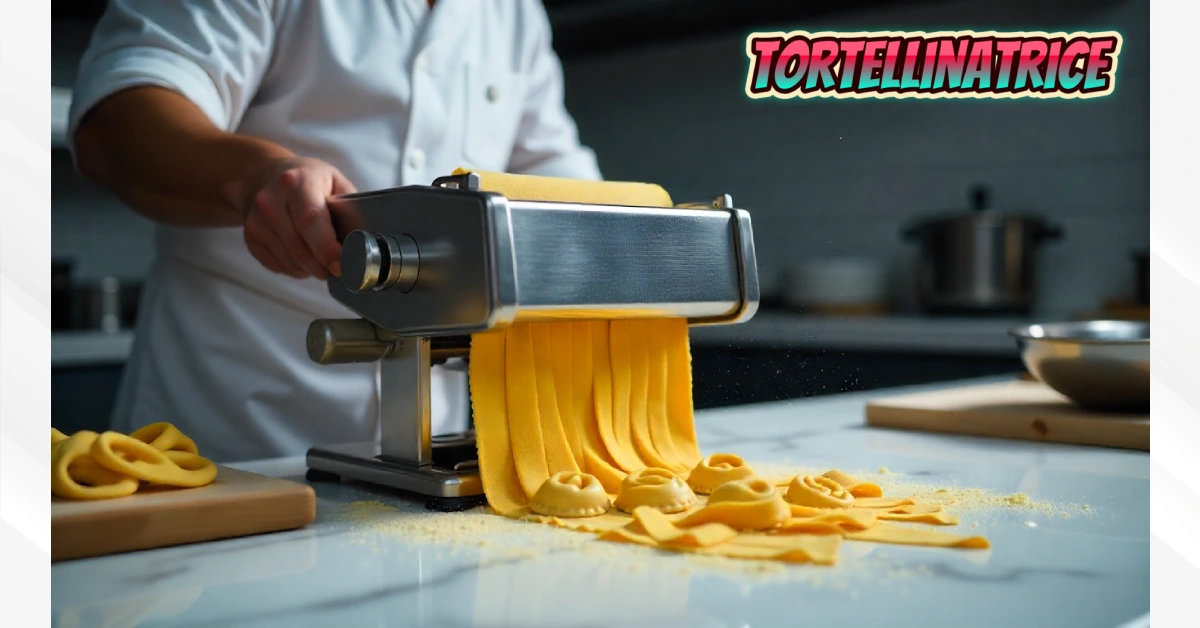
If you’ve ever watched someone fold tortellini by hand, you know it’s no small feat. The tortellinatrice is the machine that changed all of that — automating one of Italy’s most time-consuming pasta traditions without losing the precision the dish demands. Whether you’re running a busy restaurant kitchen, a pasta production facility, or simply passionate about fresh pasta at home, this article breaks down everything you need to know: what the tortellinatrice is, how it works, which models exist, and how to pick the right one for your setup.
What Is a Tortellinatrice?
The name itself tells you what it does. In Italian, “-atrice” is a suffix that denotes a machine or device — so tortellinatrice literally means a tortellini-making machine. It’s built specifically to produce the small, ring-shaped pasta that’s been a staple of Emilia-Romagna cooking for centuries.
But it’s more than just a cutter. A proper tortellinatrice handles the entire process in one pass — sheeting the dough, depositing the filling, folding the pasta into shape, and cutting each piece to size. What would take a skilled pasta maker an hour to produce by hand, a machine can replicate in minutes, with every single piece coming out the same size and shape.
That consistency isn’t just about looks. Uniform tortellini cook evenly. In a restaurant or commercial kitchen, that matters — you can’t have half the plate overcooked while the rest is still firm.
From Hand-Rolled to Machine-Made
Tortellini trace their roots to Bologna and Modena, two cities in Italy’s Emilia-Romagna region that still take enormous pride in the dish. Traditionally, the women who made pasta by hand — called sfogline — would roll thin sheets of egg dough, cut small squares, place a pinch of filling at the center, and fold each piece into the iconic navel shape. It was skilled, slow, and deeply labor-intensive work.
As demand for fresh pasta grew beyond what small family operations could manage, the need for mechanization became obvious. Early pasta machines appeared in Italian factories during the 20th century. Over time, they got smaller, smarter, and more affordable — moving from large industrial floors into professional kitchens, and eventually into home use.
Today’s tortellinatrice is a direct evolution of that history. It doesn’t replace the craft so much as it scales it.
Core Components and How It Works
Understanding the machine’s parts helps you use it better — and troubleshoot it faster. Most models share the same core structure, even if the size and output differ.
Here’s how the process flows from start to finish:
| Step | What Happens |
|---|---|
| 1. Dough Sheeting | Rollers flatten the pasta dough to a precise, even thickness |
| 2. Filling Injection | A hopper deposits measured portions of filling at consistent intervals |
| 3. Folding & Shaping | Mechanized molds press and fold each piece into the classic ring form |
| 4. Cutting | A blade or die cleanly separates each finished tortellino |
| 5. Ejection | Finished pieces drop onto a tray or belt, ready for cooking or packaging |
The dough feeder and the filling unit work in sync — if either gets out of rhythm, you end up with uneven filling or poorly sealed edges. That’s why dough consistency matters just as much as the machine itself.
Types of Tortellinatrice Models
Not every tortellinatrice is built for the same job. The market covers a wide range of use cases, from home kitchens to high-volume production lines.
- Tortellinatrice professionale — Built for restaurants and catering operations. Higher output, sturdier construction, and longer run times.
- Tortellinatrice casalinga — Compact home version. Lower output, but easier to store and clean.
- Tortellinatrice manuale — Hand-operated, no motor. Good for small batches or those who prefer a hands-on approach.
- Tortellinatrice economica — Entry-level price point. Works well for beginners or low-frequency use.
- Tortellinatrice usata — Second-hand machines. Can offer strong quality at a lower cost if bought from a reputable source.
Some models also come with interchangeable attachments for ravioli or cappelletti, which gives you more flexibility without buying a separate machine entirely.
How Do You Choose the Right Model?
The biggest mistake people make is buying based on price alone. Before you spend anything, get specific about what you actually need.
Volume is the first number to nail down. Compact home models handle a few hundred grams per session. Commercial-grade machines — like Officina DEA’s D140 — produce around 25 kg per hour, while the D250 pushes 50 kg per hour. There’s no point paying for capacity you won’t use, and there’s no point buying a machine that can’t keep up with your kitchen.
Material matters more than most buyers expect. The best professional machines are built from stainless steel — it handles repeated cleaning, resists corrosion, and meets food safety standards. Avoid models with plastic components in areas that contact food directly, especially if you’re running frequent sessions.
Ease of cleaning should be non-negotiable. Look for removable parts, smooth surfaces, and minimal crevices where dough can hide. A machine that takes 45 minutes to clean properly won’t stay in regular use for long.
Finally, consider versatility. If your menu includes ravioli or other stuffed pasta, a machine with swappable dies or attachments saves you both money and storage space.
Maintenance and Best Practices
A tortellinatrice runs best when you feed it the right dough. The dough should be smooth, elastic, and not sticky — too wet and it clogs the rollers, too dry and it tears before it folds. Most recipes recommend a firm egg-based dough rested for at least 20–30 minutes before use.
The filling needs the same attention. It should be well-blended and not overly wet. Excess moisture causes the pasta to leak at the seal, which ruins the shape and makes a mess of the machine’s folding mechanism.
After each session, disassemble all removable parts and clean them promptly. Dried dough is harder to remove and can harbor bacteria if left. Wipe down rollers, check the filling hopper for residue, and dry everything fully before storing or running the next batch. Industrial models sometimes include Clean-In-Place (CIP) systems that flush the machine automatically — a real time-saver in high-volume environments.
Stick to the manufacturer’s maintenance schedule for lubrication and mechanical checks. A well-maintained machine lasts years; a neglected one fails at the worst possible moment.
Conclusion
The tortellinatrice earns its place in any kitchen that takes fresh pasta seriously. It handles the most tedious part of tortellini production — the folding and shaping — with a level of speed and consistency that hands simply can’t match at scale. But the machine is only as good as the inputs you give it. Nail your dough, get the filling right, and keep up with cleaning, and it’ll return the favor with reliable output every time.
Choosing the right model comes down to three practical factors: how much you’re making, how often you’re making it, and how much space and budget you’re working with. Match those honestly and you’ll end up with a machine that genuinely fits your workflow — not one that collects dust after the first few uses.